
Discover how to calculate and maximize ROI for cybersecurity using formulas like ROSI and ALE. Learn best practices, and see real-world examples of organizations improving their security posture while aligning with business objectives. This article delves into the complexities of calculating and demonstrating cybersecurity ROI, offering insights into best practices and real-world examples to help CISOs and IT leaders make more informed decisions. And this is just beginning! Find out even more details at NEXT IT Security conference in Stockholm (March 13, 2025).
Understanding Cybersecurity ROI: Measuring Value Beyond Costs
For many organizations, the return on investment or precisely – Return on Security Investment (ROSI) remains a challenging metric to define. Unlike traditional investments that yield tangible financial gains. In today’s digital landscape, cybersecurity investments are critical, but the challenge remains: how do we accurately measure their ROI? Traditional investment models often fall short in the cybersecurity realm because it’s not just about direct financial returns—it’s about risk mitigation and long-term resilience. Measuring Cybersecurity ROI means understanding the broader impact of preventing attacks, maintaining compliance, and safeguarding your brand’s reputation.
Framing cybersecurity ROI purely in financial terms may not always capture the full value. Instead, we must consider both direct and indirect returns—like customer retention, regulatory compliance, and operational continuity—which are particularly relevant in regions like the Nordics, where data protection regulations are stringent and fines for non-compliance can be substantial .
How to Calculate ROI for Your Cybersecurity Investments
Calculating Cybersecurity ROI goes beyond standard ROI formulas. The cybersecurity industry often uses Return on Security Investment (ROSI), a specific adaptation of traditional ROI models, which accounts for avoided losses as a key factor. Here’s how it’s done:
Formula: ROSI Calculation

Where:
- Monetary Value of Risk Reduction = The expected financial loss from cyber threats, had no security measures been implemented.
- Cost of Security Investment = The total amount spent on cybersecurity solutions.
This formula quantifies the savings from prevented incidents relative to the cost of implementing those security measures. It’s a way to understand cybersecurity as a preventive investment rather than just a cost center.
Real-Life Example: Implementing ROSI in Practice
Let’s apply this to a real scenario. Imagine a logistics company facing an increasing number of phishing attacks. Their risk assessment identifies that, without security measures, they stand to lose €2 million annually due to data breaches, operational downtime, and lost business. They decided to invest €500,000 in a robust email security platform and staff training.
Step 1: Calculate the Monetary Value of Risk Reduction.
- Estimated annual loss without security = €2 million.
- Expected risk reduction after security implementation = 90%.
Monetary Value of Risk Reduction = 90% of €2 million = €1.8 million.
Step 2: Use the ROSI formula.
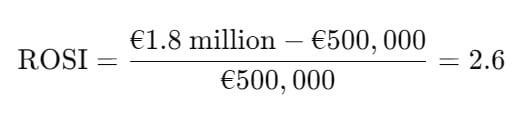
In this case, the ROSI is 2.6, meaning the organization receives €2.60 in value for every €1 spent on security. This shows that the investment yields a significant return by preventing future losses.
This approach stresses that cybersecurity investments should be prioritized based on risk assessments that quantify potential losses from different threat scenarios.
Best Practices for Maximizing Cybersecurity ROSI
Once you understand how to calculate Cybersecurity ROI, the next step is optimizing your security strategy to maximize returns. Here are some best practices:
1. Prioritize High-Risk Areas with Quantified Losses
Focusing cybersecurity efforts where the highest potential financial losses lie. Using quantitative risk analysis, you can assign monetary values to various threats, allowing you to prioritize your investments.
Formula: Loss Expectancy
The Annualized Loss Expectancy (ALE) formula helps calculate the potential losses an organization might face from specific risks.

Where:
- SLE = Estimated monetary loss for a single incident (e.g., a ransomware attack).
- ARO = Number of times the incident is expected to occur in a year.
Real-Life Example: Calculating ALE
For a financial institution, let’s say the SLE of a successful phishing attack is estimated to be €500,000. Based on past data, they expect such an attack to succeed twice per year, making their ARO = 2.

This figure represents the potential annual loss without sufficient cybersecurity defenses. With this data, the company can decide whether to invest in anti-phishing technologies, knowing that mitigating this risk would avoid significant financial damage.
2. Implement Automation to Reduce Operational Costs
Automating security tasks like threat detection, incident response, and patch management not only reduces costs but also improves efficiency. For example, Finnish banks have invested in automated fraud detection systems, reducing incident response times from hours to minutes, which in turn lowers the Cybersecurity Cost-Benefit Analysis by minimizing downtime and potential losses .
Aligning Cybersecurity Investments with Business Objectives for Better ROI
One critical aspect of cybersecurity is ensuring that Security Investments are aligned with broader business goals. A focus on compliance, customer trust, and long-term resilience leads to better ROI.
3. Align Investments with Regulatory Compliance
In the Nordic countries, where data protection regulations like GDPR are strictly enforced, compliance is a top business objective. Non-compliance can result in significant fines and reputational damage, making upfront investments in cybersecurity worthwhile. For instance, a Swedish healthcare provider invested heavily in a security overhaul after facing potential GDPR fines of up to €10 million. As a result, they avoided both the fines and the reputational damage that would have followed .
4. Strengthen Customer Trust for Long-Term ROI
As TrueFort points out, strong cybersecurity can directly impact customer trust. Companies that can demonstrate robust security postures are more likely to retain customers and attract new ones. A Norwegian e-commerce company, for example, saw a 15% increase in customer retention after investing in enhanced security protocols and publicly demonstrating their commitment to data protection .
Real-Life Example: Maersk’s Massive Cybersecurity Investment Payoff
Maersk’s long-term cybersecurity investment following the 2017 NotPetya attack is a clear example of aligning cybersecurity with business resilience. After suffering losses of up to $300 million, Maersk invested heavily in building a more resilient infrastructure. This included implementing automation, strengthening internal processes, and ensuring faster recovery times from future incidents. The return on this investment became evident when Maersk was one of the few companies able to quickly recover from subsequent attacks, avoiding further financial and reputational damage.
Conclusion
In today’s interconnected world, the ROI for cybersecurity is about far more than just financial gain—it’s about risk reduction, compliance, and long-term business viability. For cybersecurity professionals and IT leaders, it’s crucial to understand that Cybersecurity Cost-Benefit Analysis must account for both the direct and indirect benefits of security investments. Whether through risk mitigation, improved customer trust, or compliance, a well-executed cybersecurity strategy can deliver profound returns over time.
The key takeaway: while cybersecurity ROI may be complex, the effort to quantify and communicate its value is well worth it. By aligning cybersecurity with business objectives and leveraging best practices, organizations can maximize the Cybersecurity Return on Investment, ensuring resilience against evolving threats.
Cybersecurity ROI is a multifaceted metric that goes far beyond simple cost comparisons. By focusing on risk reduction, aligning security investments with business objectives, and leveraging frameworks like ROSI and ALE, organizations can measure the true value of their cybersecurity initiatives.
Finally – the Cybersecurity Return on Investment is maximized when investments are strategic, risks are prioritized, and automation and compliance efforts are embedded into the security strategy. In an increasingly regulated and interconnected world, demonstrating the value of cybersecurity investments is no longer optional—it’s an imperative.